

 English
 français
 español
 العربية
Поиск
Что Вы ищете?
Поиск

Mobile cellular towers for emergency communication are designed around three core principles: extreme portability, rapid deployment, and self-sufficiency. Unlike permanent macro sites, these structures (which include Cell on Wheels (COW) and Rapidly Deployable Towers) utilize lightweight, modular steel frameworks or telescopic masts that can be transported by standard trucks or helicopters. They feature pre-integrated equipment cabinets, quick-connect antenna mounts, and independent power supplies, allowing a fully functional network node to be established in hours—or even minutes—without the need for concrete foundations or heavy construction equipment.
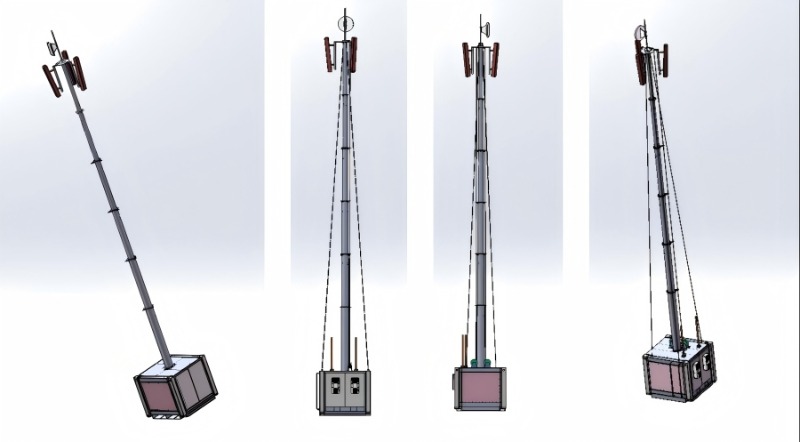
· Weight and Volume Optimization: Structural members are designed with optimized cross-sections (e.g., high-strength steel angles or tubular sections) to minimize weight, allowing components to be manually carried or transported on light trailers.
· Rapid Deployment Mechanisms: Designs often utilize telescopic masts, hinged base plates, or modular bolted flanges, eliminating the need for field welding and allowing assembly by a small crew.
· Self-Sufficiency: The tower base or trailer is designed to house backup power (generators or batteries) and cooling systems, ensuring the site operates independently of the local power grid.
· Environmental Resilience: Despite being temporary, these structures must withstand the harsh conditions often present post-disaster (e.g., high winds, rain, and debris), requiring robust structural analysis and hot-dip galvanizing.
· Equipment Integration: Platforms are pre-drilled and engineered to hold standard cellular equipment (BBUs, RRUs, microwave links) with standardized interfaces for quick connection.
When a natural disaster or major event occurs, the local telecommunications infrastructure may be damaged or overloaded. The primary goal of an emergency cellular tower is to restore communication for first responders and the public as quickly as possible.
This environment dictates specific engineering requirements:
· Logistical Accessibility: Roads may be blocked. The tower design must allow for transport by 4x4 vehicles, light trucks, or aerial drop.
· Zero-Foundation Setup: There is no time to pour concrete. The tower must rely on ballast weights, ground anchors, or integrated trailer chassis for stability.
· Rapid Commissioning: The structural assembly must be straightforward, minimizing the need for specialized rigging or certified welders on-site.
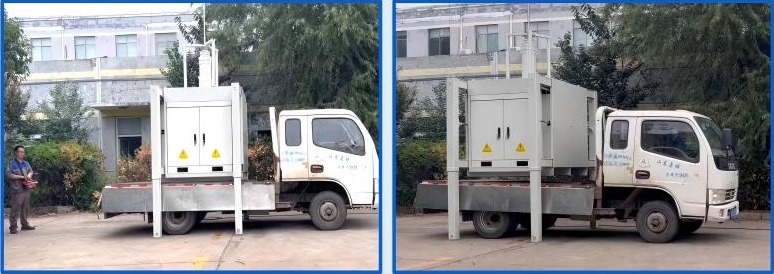
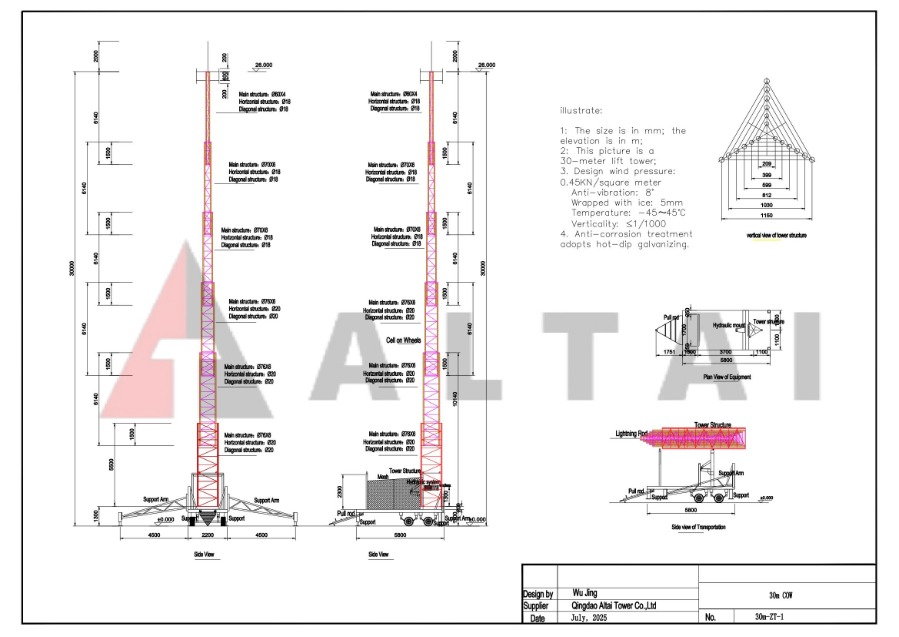
To achieve rapid deployment, the structural design abandons traditional heavy lattice construction in favor of specialized configurations.
The tower body is typically segmented into manageable lengths (e.g., 1 to 2.5 meters per section) that can be easily lifted by two or three technicians. This is often achieved using high-strength, low-alloy steel (such as Q355B) with CNC-punched holes to ensure seamless, immediate alignment during bolting.
For lower-height requirements (up to 15 to 25 meters), telescopic masts are common. These masts use winch or hydraulic mechanisms to extend the tower vertically. The joints are designed with precise overlapping tolerances to maintain structural rigidity when fully extended.
Instead of massive concrete footings, emergency towers use:
· Trailer-Mounted Chassis: For COWs, the trailer itself provides the base, utilizing hydraulic outriggers to level the system and distribute ground pressure.
· Ballast Frames: For standalone deployable towers, a steel frame is filled with local materials (water bladders, concrete blocks, or earth) to resist overturning moments.
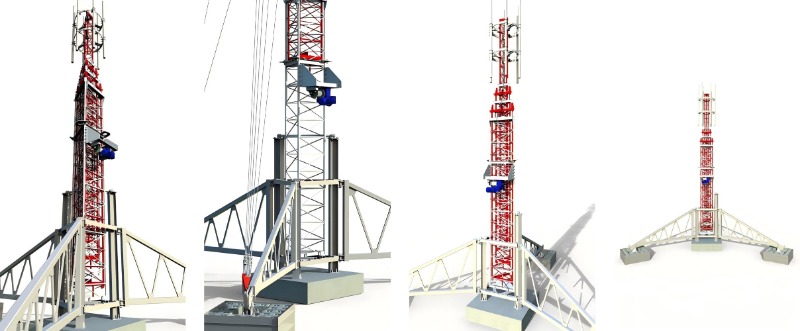
The tower platform must facilitate the rapid mounting of heavy cellular antennas and radio units (RRUs).
· Pre-Wired and Pre-Assembled: Emergency towers often feature cabinets that are delivered with BBUs, power distribution units (PDUs), and cooling systems already installed and tested.
· Quick-Connect Antenna Brackets: Mounting points are designed for rapid attachment. The CNC precision manufacturing of the mounting plates ensures that standard antenna pipe diameters clamp securely without the need for custom fabrication on-site.
· Cable Management: Pre-routed conduits or simple, heavy-duty cable ties are used to secure RF jumpers and power cables, protecting them from wind damage during the deployment phase.
Even though they are temporary, emergency towers must survive the elements.
· Wind Load Design: These towers must be analyzed for high wind speeds (often rated for survival wind speeds of 150 km/h to 200 km/h or higher) to ensure they don't collapse during the aftershocks of a storm.
· Hot-Dip Galvanizing: To prevent corrosion, especially in disaster zones involving flooding or coastal areas, all steel components undergo hot-dip galvanizing (ASTM A123). This provides a tough zinc coating that resists rust and ensures the tower can be reused for decades.
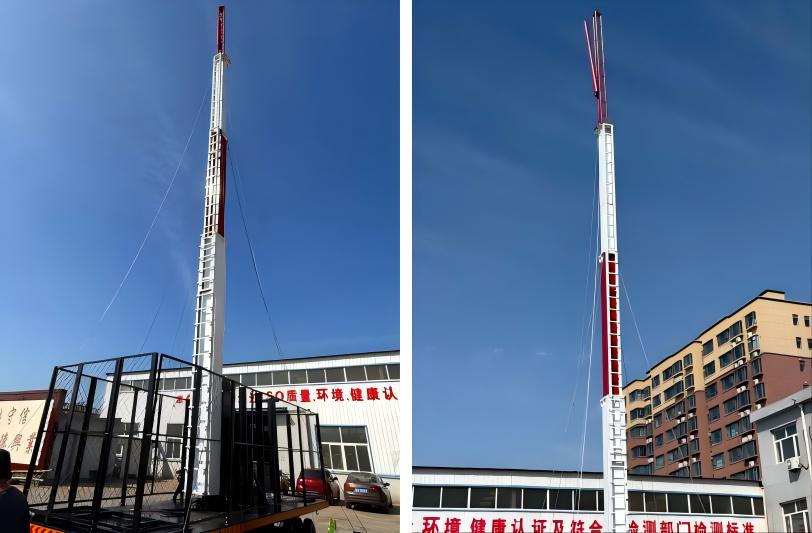
Designing a structure that balances lightweight portability with heavy-duty stability requires advanced structural analysis and precise manufacturing.
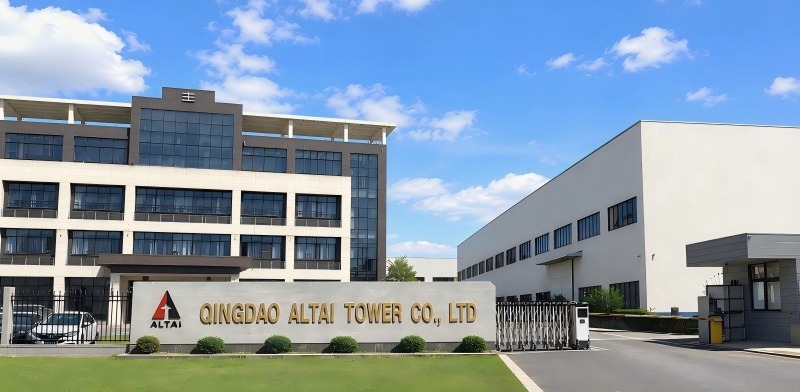
At Altai Tower, we apply our expertise in customized steel design and manufacturing to support emergency communication infrastructure:
· Advanced Structural Analysis: Our engineers use software such as SAP2000 and MS Tower to perform Finite Element Analysis (FEA). We simulate extreme wind loads and dynamic equipment weights to ensure that lightweight, deployable tower sections maintain structural integrity.
· CNC Precision for Rapid Assembly: For emergency structures, every minute on-site counts. We utilize CNC cutting and drilling to guarantee that all bolt holes are perfectly aligned. This allows modules to be assembled rapidly on-site without field reaming or modification.
· In-House Hot-Dip Galvanizing: We subject all steel components to rigorous hot-dip galvanizing (ASTM A123). This protects the tower against harsh outdoor environments and ensures a long maintenance-free service life, whether it is stored in a warehouse or deployed in a flood zone.
· Complete Export Packaging: For disaster management agencies and telecom operators, we provide specialized export packaging that keeps components organized by assembly sequence, ensuring the right parts are available immediately upon arrival.
| Parameter | Emergency Deployable Tower | Traditional Macro Tower |
|---|---|---|
| Deployment Time | Hours (or <1 hour for telescopic masts) | Weeks to months |
| Foundation | None / Ballast / Ground Anchors | Deep concrete foundation |
| Transport | Standard trucks or trailers | Heavy flatbeds; specialized logistics |
| Assembly | Small crew, bolted, no welding | Cranes, certified welders |
| Corrosion Protection | Mandatory hot-dip galvanizing | Hot-dip galvanizing + possible paint |
| Height | Usually 10m – 30m | 30m – 100m+ |
Q1: How fast can an emergency communication tower be fully deployed?
A: With a trailer-mounted COW (Cell on Wheels) or a pre-assembled telescopic mast, the tower can be leveled, elevated, and commissioned within 1 to 3 hours. For modular bolted towers, assembly typically takes 4 to 8 hours, depending on the height and crew size.
Q2: Can emergency towers be installed on uneven ground?
A: Yes. Trailer-based systems utilize hydraulic outriggers with leveling capabilities. Standalone modular towers can use adjustable base plates or ground anchors to accommodate slight slopes, eliminating the need for site excavation or grading.
Q3: How does hot-dip galvanizing help emergency towers?
A: Emergency towers are often stored outdoors or deployed in harsh post-disaster conditions (floods, storms). Hot-dip galvanizing to ASTM A123 provides a robust zinc coating (typically 85 μm) that prevents rust, ensuring the structural integrity is preserved and the tower can be rapidly redeployed multiple times over its lifespan.
Q4: What is the typical load capacity of an emergency antenna platform?
A: Load capacity varies, but an emergency platform is typically designed to support 2 to 3 sector antennas, along with RRUs and a microwave dish, totaling several hundred kilograms. The platform must also support the live load of maintenance personnel.
Q5: Do emergency towers require specialized software for structural design?
A: Yes. Because they are often tall and relatively lightweight, and sometimes lack deep foundations, dynamic wind loading is critical. Engineers use Finite Element Analysis (FEA) tools like SAP2000 to accurately model the overturning moments and ensure the ballast or anchor system is sufficient.
Designing structures for emergency communication is a unique engineering challenge. It requires a shift from permanent, heavy construction to lightweight, rapid-deployment solutions without sacrificing structural safety. From modular bolted frames to telescopic masts, every component must be optimized for speed and portability.
At Altai Tower, we leverage advanced structural modeling, CNC precision manufacturing, and in-house hot-dip galvanizing to produce steel components that meet these demanding requirements.
Planning an emergency network or temporary coverage project? Contact our engineering team with your required height, wind load specifications, and equipment weight. We will help you engineer a reliable, fast-deployable structural solution.



 Поддерживается сеть IPv6